
Digital Securities Sandbox: A Field Guide for Founders and Institutions
The financial industry is undergoing a profound transformation as technology, regulation, and investor expectations continue to evolve. At Liquida, we closely follow these developments while building solutions designed to address some of the most persistent inefficiencies in modern financial markets.
Our team is focused on understanding where the industry is heading and how emerging platforms, technologies, and investment models will shape the next decade of financial infrastructure. You can learn more about our mission and the team behind the project on our About Us page.
What Problem the DSS Is Trying to Solve
Financial markets run on infrastructure designed decades ago. Despite enormous technological progress, core securities infrastructure still relies on:
- Centralised ledgers
- Multiple intermediaries
- Multi-day settlement cycles
- Fragmented record-keeping
For example, equity or bond trades typically settle two days after execution (T+2) through a network of brokers, clearing houses and central securities depositories. This model works but it is operationally complex and expensive.
Distributed ledger technology (DLT) introduces the possibility of:
- Near-instant settlement
- Shared ledgers between institutions
- Programmable asset ownership
- Integrated trading and settlement infrastructure
The challenge is confidence. Financial regulators cannot simply replace the infrastructure underpinning capital markets overnight. The Digital Securities Sandbox (DSS) was created to solve this problem.
It allows regulators and market participants to test whether distributed ledger infrastructure can safely operate inside regulated financial markets.
Rather than theoretical research, the DSS enables live market experiments within controlled limits.
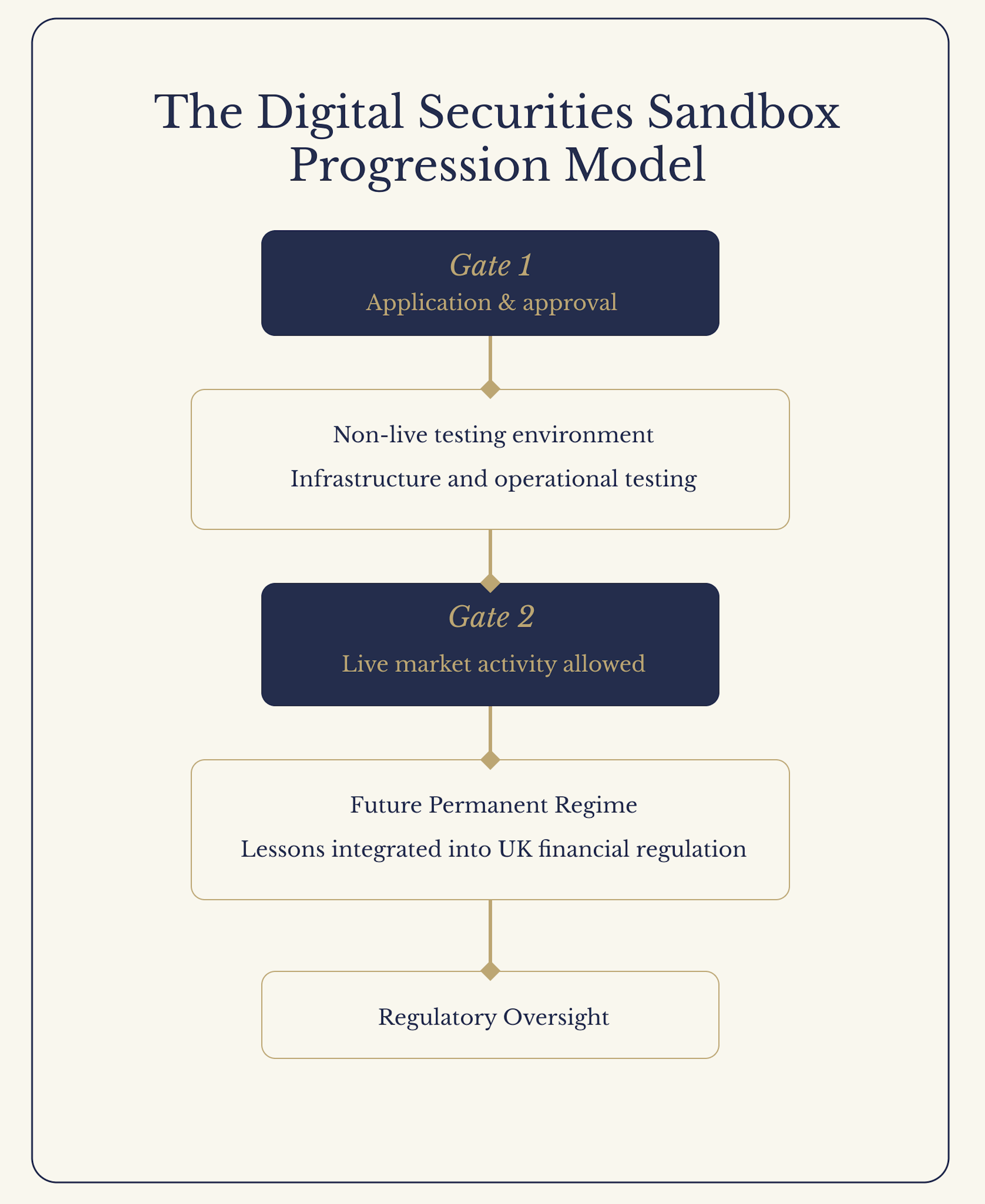
The DSS Glidepath: Stages and Gates Explained
The DSS is structured as a multi-stage testing programme, designed to gradually increase scale while maintaining regulatory oversight.
Instead of allowing firms to deploy new infrastructure immediately, the sandbox uses a gated progression model.
This ensures risk remains contained while regulators learn from real market activity.
The DSS Glidepath
Sandbox Approval Notices (SANs)
Each DSS participant receives a Sandbox Approval Notice (SAN). A SAN defines the operational boundaries for each participant.
This includes limits such as:
- Maximum transaction volume
- Types of securities permitted
- Settlement models allowed
- Operational controls required
In practice, SANs function as custom regulatory guardrails.
They ensure that:
- Risk remains contained
- Regulators can learn from real market activity
- The sandbox can evolve safely
Over time, SANs may be adjusted as regulators gain confidence in the infrastructure.
Digital Securities Depositories vs Traditional CSDs
One of the most interesting design choices in the DSS is the introduction of the Digital Securities Depository (DSD). Traditional financial markets rely on Central Securities Depositories (CSDs). These institutions maintain the official records of securities ownership. Examples include organizations such as Euroclear UK & International.
CSDs operate under extremely strict regulatory frameworks because they form part of the core settlement infrastructure of capital markets.
The DSS introduces the concept of a Digital Securities Depository, which performs similar functions but using distributed ledger technology. However, regulators have explicitly acknowledged that DSDs operate in a higher-risk experimental environment. This is intentional.
Because the sandbox is designed for experimentation, DSDs are permitted to operate with:
- Modified regulatory requirements
- Controlled market limits
- Strong supervisory oversight
This allows regulators to test the viability of DLT-based settlement infrastructure without exposing the broader financial system to risk.
We believe that the next wave of financial innovation will come from companies that combine deep market understanding with scalable technology. Our team is actively working toward building a platform designed to unlock new opportunities within the financial ecosystem.
For those interested in the people and ideas behind this initiative, you can explore the background of our team on our Meet the Team page.
Who Has Gate 1 Approval Today
One of the most important indicators of the sandbox’s direction is which institutions have already entered it. According to the Bank of England DSS dashboard, Gate 1 entrants include institutions such as:
- Euroclear UK & International
- Tradeweb Markets
- London Stock Exchange Group
- J.P. Morgan Securities
This matters for market structure. These firms operate major parts of the existing financial system. Their participation signals that the sandbox is not simply a fintech experiment, it is a collaborative effort between regulators and incumbent market infrastructure providers.
If the DSS succeeds, it could influence the future architecture of:
- securities settlement
- digital asset issuance
- regulated on-chain markets
The DIGIT Instrument
The UK government has also indicated that DIGIT, a digital government instrument, will be issued within the DSS environment. This signals an important policy direction.
Rather than restricting tokenisation to private assets, regulators are exploring how public financial instruments could operate within distributed ledger infrastructure.
This approach allows policymakers to evaluate how tokenisation interacts with:
- sovereign debt markets
- institutional trading venues
- regulated settlement systems
The Closing Window Reality
The DSS is not an open-ended programme. The sandbox currently operates within a defined regulatory window that runs through mid-2027. For firms considering participation, this creates a clear strategic timeline.
Participants entering early will have more time to:
- conduct infrastructure testing
- iterate operational models
- gather regulatory feedback
Late entrants may face tighter timelines before the sandbox transitions into a future permanent regime. For investors, the timeline also provides an important signal. The DSS is not simply a discussion about financial innovation, it is a live regulatory experiment with defined milestones.
While our platform is currently under development, our focus remains on building the infrastructure, partnerships, and expertise necessary to support the future of financial innovation.
We welcome conversations with investors, strategic partners, and industry professionals who share our long-term vision for the financial sector, Contact-Us.
Frequently Asked Questions
Can a trading venue join the DSS alone?
Yes, depending on the structure of the proposal.
However, most sandbox experiments involve multiple participants across the market infrastructure stack.
These may include:
- trading venues
- digital securities depositories
- settlement providers
- custodians
Collaborative structures allow regulators to observe how the full transaction lifecycle operates on distributed infrastructure.
When can firms go live?
Live market activity begins once firms progress beyond the initial testing stage and receive the relevant regulatory permissions.
Even at this stage, activity remains subject to SAN restrictions and scale limits.
Do SAN conditions change over time?
Yes.
SANs may be adjusted as regulators gain greater confidence in a participant’s infrastructure and operational controls.
This adaptive framework allows the sandbox to evolve while maintaining risk controls.
Why the DSS Matters
The Digital Securities Sandbox represents one of the most ambitious regulatory experiments currently underway in global financial markets.
Rather than banning or ignoring distributed ledger technology, UK regulators have chosen a different approach:
Controlled experimentation within regulated infrastructure.
This model allows policymakers to answer key questions:
- Can tokenised securities operate safely within regulated markets?
- Can settlement systems be redesigned using distributed ledgers?
- What safeguards are required before scaling these systems globally?
The answers to these questions may shape the next generation of financial infrastructure.
For founders, institutions and investors alike, the DSS offers an early glimpse into how regulated on-chain capital markets may evolve.
If you are interested in learning more about our vision, exploring potential collaboration, or discussing investment opportunities, we invite you to connect with our team.
You can learn more about our company on our About Us page, meet the people building the project on the Meet the Team page, or reach out directly through our Contact Us page to start a conversation.
Disclaimer: The content published on this website is provided for informational purposes only and should not be interpreted as financial, investment, or regulatory advice.