
Atomic settlement in central bank money x RTGS synchronisation
The financial industry is undergoing a profound transformation as technology, regulation, and investor expectations continue to evolve. At Liquida, we closely follow these developments while building solutions designed to address some of the most persistent inefficiencies in modern financial markets.
Our team is focused on understanding where the industry is heading and how emerging platforms, technologies, and investment models will shape the next decade of financial infrastructure. You can learn more about our mission and the team behind the project on our About Us page.
Tokens don’t fix settlement
Much of the conversation around digital assets focuses on tokenisation, it must be a candidate for the oxford word of 2026. Tokenised securities. Tokenised deposits. Tokenised funds. But the Bank of England is focused on something else, settlement. Because without changing how settlement works, tokenisation does not eliminate:
- counterparty risk
- settlement delays
- dependency on intermediaries
This is why the BoE is investing in RTGS synchronisation, as a way to enable atomic settlement in central bank money.
What is atomic settlement?
At its core, atomic settlement means that two legs of a transaction settle simultaneously, or not at all. In traditional markets, this is approximated through delivery versus payment (DvP) mechanisms. But these systems still rely on batch processes, reconciliation steps and intermediary coordination, all of which introduce risk. Atomic settlement removes this by introducing conditional execution, removing timing gaps, partial completions or residual exposure. This is why atomic settlement is often described as eliminating settlement risk at the infrastructure level.
Atomic settlement vs traditional settlement
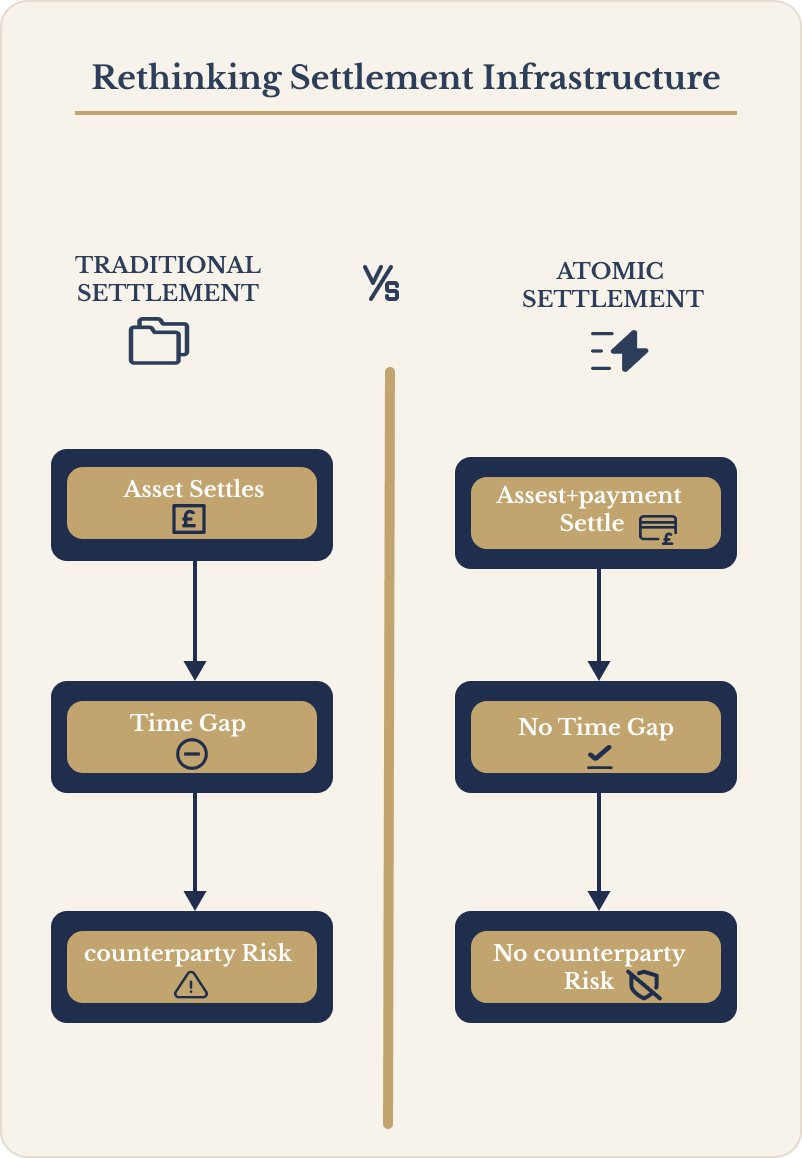
What synchronisation means in RT2 terms
RTGS synchronisation is the Bank’s approach to making atomic settlement possible without replacing the existing system. Instead of moving everything onto a blockchain, the Bank is doing something more subtle. It allows central bank money in RTGS (RT2) to settle conditionally based on events on external systems.
In simple terms funds in RTGS settle IF AND ONLY IF the asset settles on an external ledger, this key innovation means the BoE is not tokenising central bank money but It is making it programmable at the settlement layer, allowing for distributed ledgers, tokenised asset platforms and sandbox infrastructures to interact directly with central bank money, without compromising control or safety.
RTGS synchronisation model
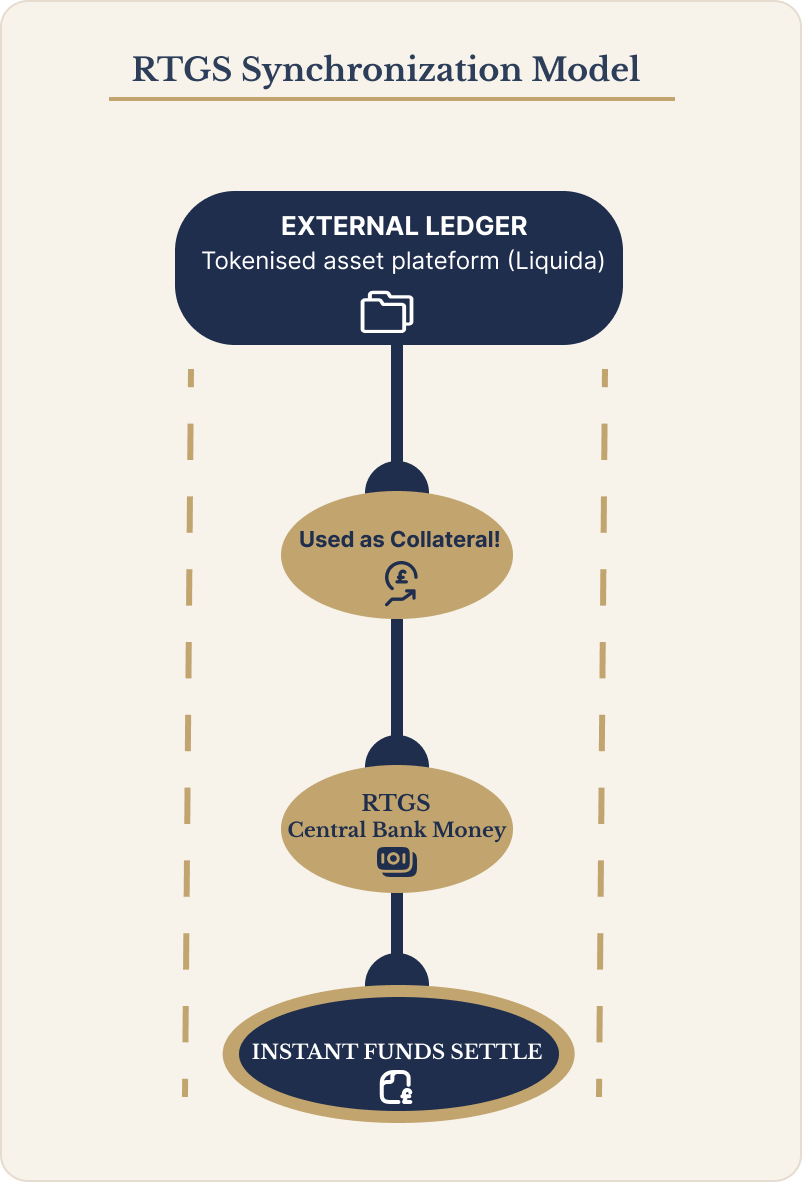
What the Synchronisation Lab actually is
The Bank of England is actively building the underlying infrastructure required for atomic settlement, and the Synchronisation Lab forms a key part of this effort. The lab is not a production system, it is a controlled, non-live testing environment scheduled to run from spring 2026 for an initial period of approximately six months.
Its purpose is to explore core technical and operational questions, including how synchronisation should be designed, how different systems can interoperate effectively, and how market participants engage with conditional settlement mechanisms in practice.
Crucially, the lab is intended to support broader ecosystem development, this includes participants from the Digital Securities Sandbox, tokenised deposit initiatives, and a range of wholesale settlement experiments.
Where this connects to RWAs and the DSS
The Synchronisation Lab is not an isolated technical exercise; it is closely linked to several of the UK’s most important initiatives in digital asset infrastructure, particularly those focused on real-world assets (RWAs) and regulated market environments.
First, the connection to the Digital Securities Sandbox (DSS) is fundamental. The DSS enables the issuance, trading, and settlement of digital securities within a controlled regulatory framework. However, for these markets to function effectively at scale, they require a reliable and trusted settlement asset. RTGS synchronisation provides a pathway for these transactions to settle in central bank money, addressing one of the core limitations of current tokenised market experiments.
Second, the Synchronisation Lab is directly relevant to tokenised deposit initiatives, such as the work led by UK Finance on Global Bank Tokenised Deposits (GBTD). This initiative has already been accepted into Synchronisation Lab testing, reflecting its importance in the broader ecosystem. Through this integration, bank-issued money, distributed ledger platforms, and central bank settlement infrastructure can begin to operate as a coordinated system rather than as isolated components.
Finally, there is a clear link to the DIGIT pilot and the broader exploration of tokenised gilts. DIGIT is designed to test the lifecycle of on-chain sovereign debt, including trading and settlement in both exchange and OTC contexts. However, as with all tokenised asset experiments, the question of settlement remains central. RTGS synchronisation provides a potential mechanism through which these instruments could ultimately settle in central bank money, aligning tokenised securities with the highest standard of settlement finality available in the financial system.
The real UK settlement architecture
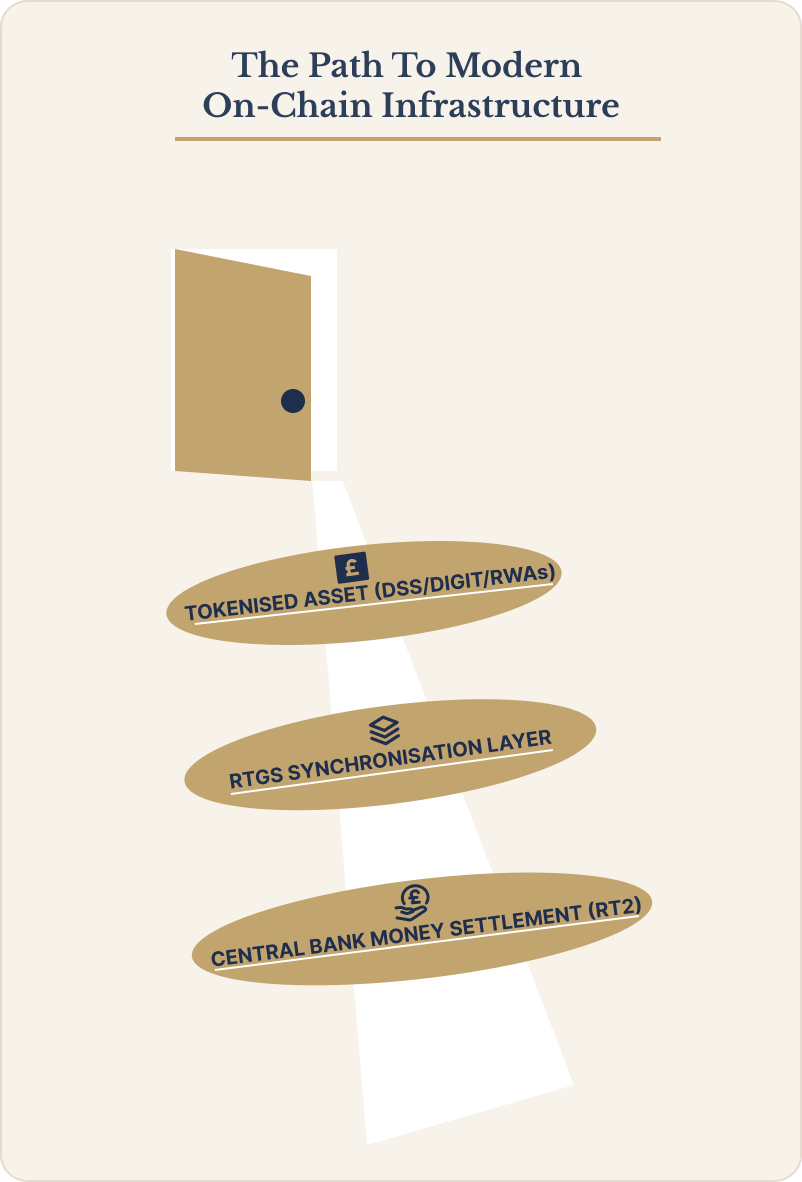
Why this is the real on-chain unlock
Much of the prevailing narrative around digital assets assumes that distributed ledger technology will ultimately replace existing financial infrastructure. The Bank of England is not going to be rebuilding the system from first principles, rather it is extending the existing core infrastructure - specifically RTGS - by introducing conditional settlement capabilities and enabling interaction with external ledgers.
This approach preserves the integrity and resilience of established systems while allowing new forms of digital infrastructure to integrate with them. In practice, this means that innovation can occur at the edges of the system, without introducing unnecessary systemic risk at the centre. The result is a more incremental but ultimately more robust form of transformation.
Crucially, it enables atomic settlement to take place in central bank money - the safest and most trusted form of settlement asset in the financial system - rather than requiring markets to rely on alternative or unproven monetary instruments.
We believe that the next wave of financial innovation will come from companies that combine deep market understanding with scalable technology. Our team is actively working toward building a platform designed to unlock new opportunities within the financial ecosystem.
For those interested in the people and ideas behind this initiative, you can explore the background of our team on our Meet the Team page.
FAQ
Is RTGS synchronisation a regulatory sandbox?
No. It is a technical testing environment, separate from regulatory sandboxes like the DSS. However, it is designed to support participants in those environments.
Will this support real money?
Not initially. The Synchronisation Lab is non-live, meaning it does not process real transactions. But it is a precursor to potential production deployment.
How does this relate to DIGIT?
DIGIT tests tokenised sovereign debt. RTGS synchronisation provides a pathway for those assets to settle in central bank money.
The real takeaway
Rather than pursuing a single form of digital money or a wholesale replacement of existing systems, policymakers are assembling a layered architecture:
- tokenised assets, developed within environments such as the Digital Securities Sandbox and pilots like DIGIT
- tokenised forms of money, including bank-issued deposits and regulated stablecoins
- and a synchronised settlement layer, anchored in RTGS
Together, these components form the basis for atomic settlement within a regulated financial system. It is upgrading the core infrastructure of the financial markets in a way that preserves trust, maintains stability, and enables new forms of interaction between assets and money.
In the long run, it represents a far more significant shift than simply placing existing instruments on-chain.
If you are interested in learning more about our vision, exploring potential collaboration, or discussing investment opportunities, we invite you to connect with our team.
You can learn more about our company on our About Us page, meet the people building the project on the Meet the Team page, or reach out directly through our Contact Us page to start a conversation.
Disclaimer: The content published on this website is provided for informational purposes only and should not be interpreted as financial, investment, or regulatory advice.