
The UK Is Quietly Building the Infrastructure for On-Chain Finance
The financial industry is undergoing a profound transformation as technology, regulation, and investor expectations continue to evolve. At Liquida, we closely follow these developments while building solutions designed to address some of the most persistent inefficiencies in modern financial markets.
Our team is focused on understanding where the industry is heading and how emerging platforms, technologies, and investment models will shape the next decade of financial infrastructure. You can learn more about our mission and the team behind the project on our About Us page.
Most discussions about the future of crypto focus on the United States.
Debates centre around the approval of Bitcoin ETFs, stablecoin legislation in Congress, or the role of large crypto exchanges in shaping financial markets.
But something much quieter and arguably more important is happening in the United Kingdom.
Across multiple regulators and institutions, the UK is laying the foundations for what could become the most regulated and institutionally integrated on-chain financial system in the world.
Three major developments signal this shift:
- The Digital Securities Sandbox (DSS) launched by the Bank of England and FCA
- The emerging regulatory framework for systemic stablecoins
- Increasing experimentation with tokenised real-world assets
Taken together, these initiatives suggest the UK is not merely reacting to crypto innovation, it is designing the regulatory architecture for tokenised finance.
The Digital Securities Sandbox: A Regulatory Testbed for Tokenised Markets
The Digital Securities Sandbox (DSS) represents one of the most significant regulatory experiments in modern financial markets.
Unlike traditional sandboxes, which allow companies to test products with relaxed rules, the DSS goes much further.
It allows firms to temporarily modify parts of UK securities law in order to test blockchain-based infrastructure for financial markets.
This includes experimentation with:
- Tokenised securities issuance
- On-chain settlement
- Distributed ledger trading infrastructure
- Digital custody models
The sandbox effectively allows market participants to test whether distributed ledger technology could replace parts of traditional financial market infrastructure.
These experiments include areas traditionally dominated by institutions such as:
- Central securities depositories (CSDs)
- Clearing houses
- Settlement systems
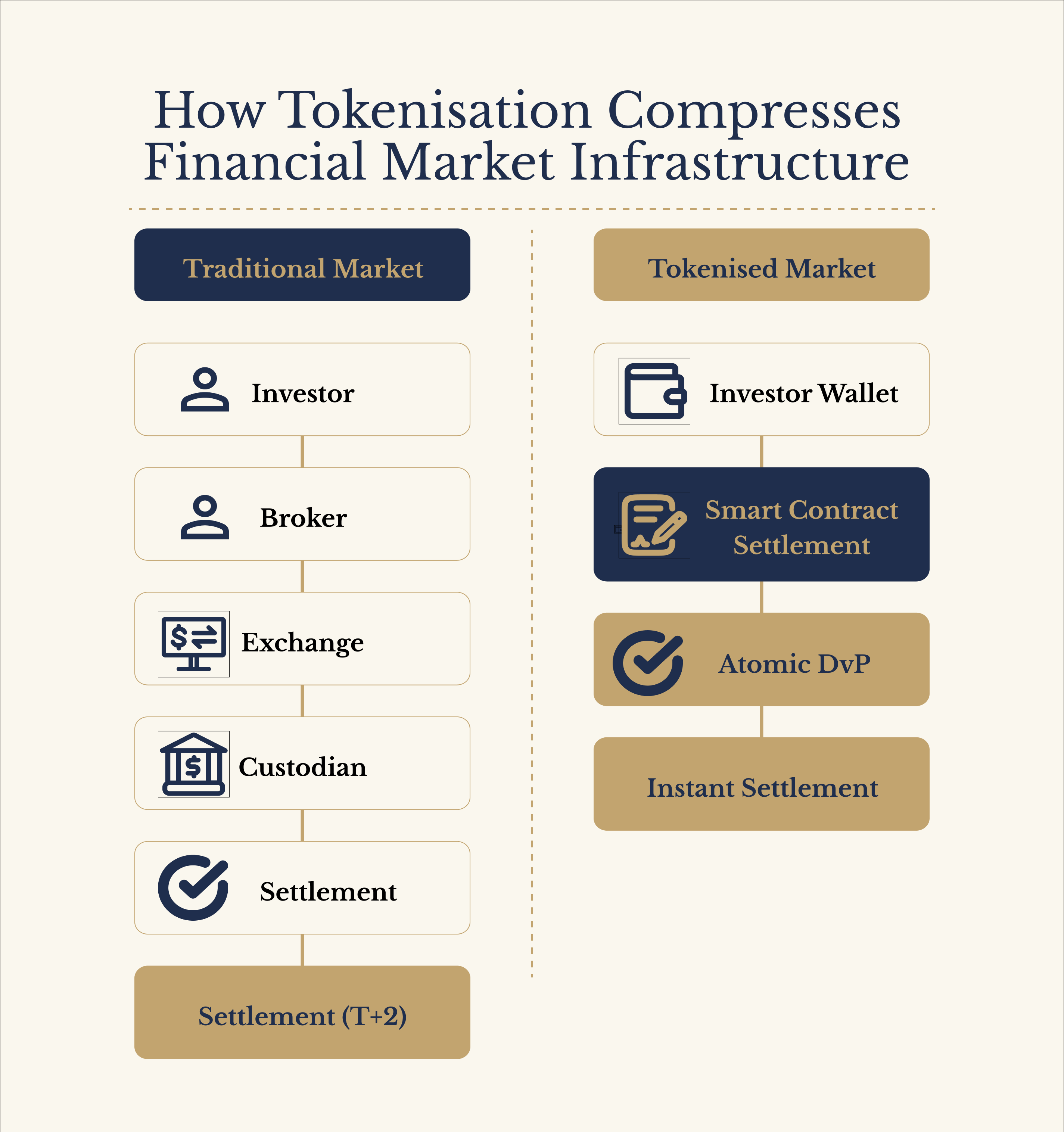
For decades, securities settlement has relied on complex intermediaries and processes that can take two days or more (T+2) to complete.
Tokenization promises something fundamentally different.
Traditional Securities Settlement vs Tokenised Settlement
Stablecoins Are Becoming Financial Infrastructure
Alongside tokenised securities experimentation, the UK is also building a framework for systemic stablecoins.
The Bank of England has proposed a regime for sterling-denominated stablecoins used for payments at scale.
The framework introduces requirements including:
- Full backing with high-quality liquid assets
- Robust redemption mechanisms
- Bank-level supervision for systemic issuers
- Operational resilience standards
In essence, the Bank of England is preparing for a future where digital money circulates on blockchain networks but remains anchored to regulated financial institutions.
This is a profound shift.
For the first time, regulators are acknowledging that:
Blockchain networks may become part of the core financial plumbing of the economy.
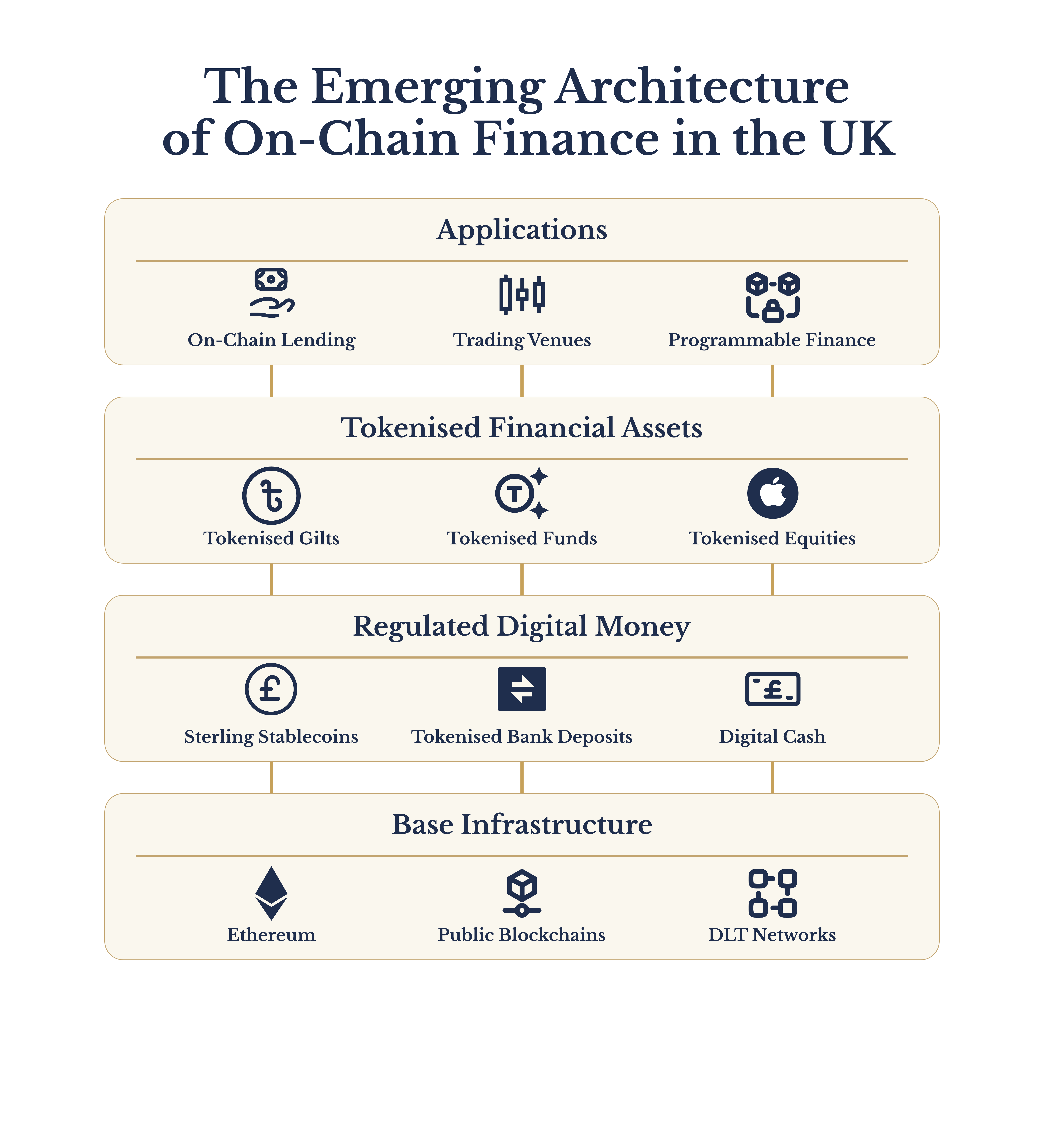
The Emerging UK On-Chain Financial Stack
Tokenised Assets Are Moving From Theory to Deployment
Institutional interest in tokenised real-world assets has accelerated rapidly.
Major financial institutions are now experimenting with tokenisation across multiple asset classes.
Examples include:
- Tokenised money market funds
- Tokenised treasuries
- Blockchain settlement pilots
- Digital collateral platforms
In many cases, these experiments are being conducted on public blockchains such as Ethereum.
The logic is increasingly clear.
Tokenisation can offer:
Programmable ownership
- Assets can be integrated into smart contracts.
Faster settlement
- Transactions can settle in minutes rather than days.
Greater transparency
- Ownership and transaction history can be recorded on shared ledgers.
Improved accessibility
- Assets can be fractionalised and made available to a broader investor base.
- For sovereign debt markets such as UK gilts, this could be particularly powerful.
Why Tokenised Gilts Could Become a Core Building Block
Short-term government bonds are one of the most important financial instruments in the global financial system.
They underpin:
- Money market funds
- Repo markets
- Collateral systems
- Liquidity management
Yet retail investors often face significant barriers to accessing these instruments directly.
These include:
- Broker minimums
- Complex trading platforms
- Settlement delays
- Lack of transparency around pricing
Tokenization could fundamentally change this landscape.
By issuing tokenised representations of government bonds, financial platforms could enable:
- Fractional access to sovereign debt
- Real-time settlement
- Transparent on-chain collateralisation
- Integration into decentralised financial applications
In this sense, tokenised gilts may become a bridge between traditional finance and programmable financial infrastructure.
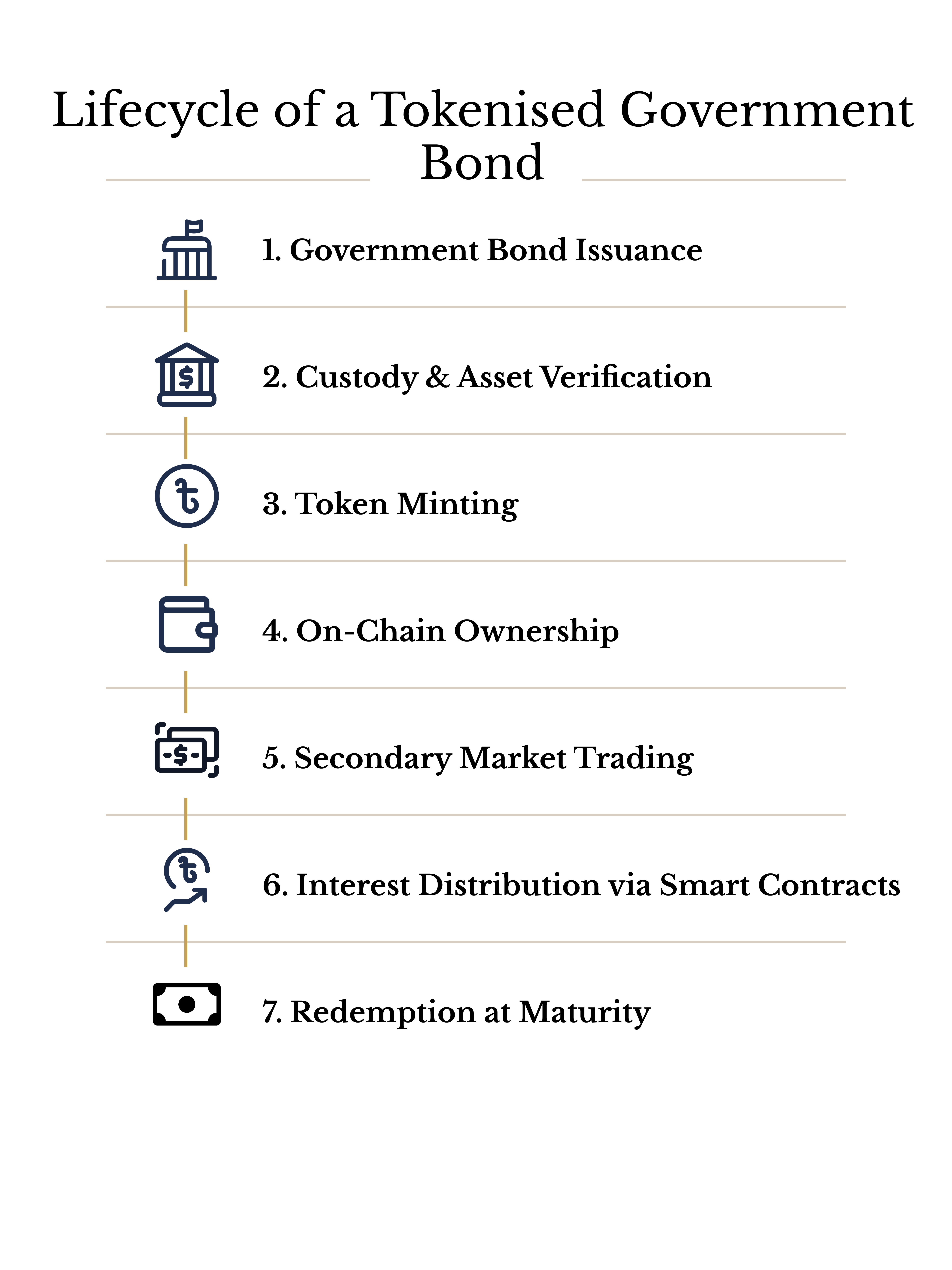
Tokenised Gilt Lifecycle
The Strategic Opportunity for the UK
While the United States debates crypto regulation, the UK has an opportunity to take a different path.
Rather than focusing on speculative crypto markets, the UK appears to be focusing on institutional financial infrastructure.
This includes:
- Regulated stablecoins
- Tokenised securities experimentation
- Digital settlement systems
The approach suggests a future where blockchain technology becomes embedded within the existing financial system rather than replacing it.
If successful, this model could position London as a global centre for regulated digital financial markets.
The Next Phase of Financial Infrastructure
Financial markets evolve slowly until they do not.
Major structural shifts often occur when three forces align:
- Technology maturity
- Regulatory clarity
- Institutional participation
Today, all three are beginning to converge around tokenised financial infrastructure.
The UK's regulatory initiatives suggest policymakers recognise this.
The next decade may determine whether blockchain networks become part of the core infrastructure of global finance.
The UK's current experiments may offer an early glimpse of that future.
If you are interested in learning more about our vision, exploring potential collaboration, or discussing investment opportunities, we invite you to connect with our team.
You can learn more about our company on our About Us page, meet the people building the project on the Meet the Team page, or reach out directly through our Contact Us page to start a conversation.
Disclaimer: The content published on this website is provided for informational purposes only and should not be interpreted as financial, investment, or regulatory advice.