
We chose Arbitrum as our native blockchain, and it wasn't because of gas fees
At Liquida we are building infrastructure to bring UK gilts onchain as institutional collateral. You can learn more about our mission and our project on our About Us page.
But this piece is not about us. It's about how we chose which blockchain to use for our application from the perspective of a team with no inherited inertia in any given ecosystem.
To be clear, we landed on Arbitrum but this isn't an argument that Arbitrum is the right answer for everyone. It's that from the lens of a product looking to onboard institutional users for RWA use cases, Arbitrum is the choice in 2026.
Metrics
Metrics aren't everything, but they're important, so let's start there. Thanks to RWA.xyz, Dune, L2BEAT, Entropy Advisors and DefiLlama for the data, all of which was read on 18 August 2026.
Arbitrum is home to more distinct real-world assets than any other chain, currently counting 3,294 tokens, ahead of Solana in 2nd at 2,677 and Ethereum in 3rd at 2,268.
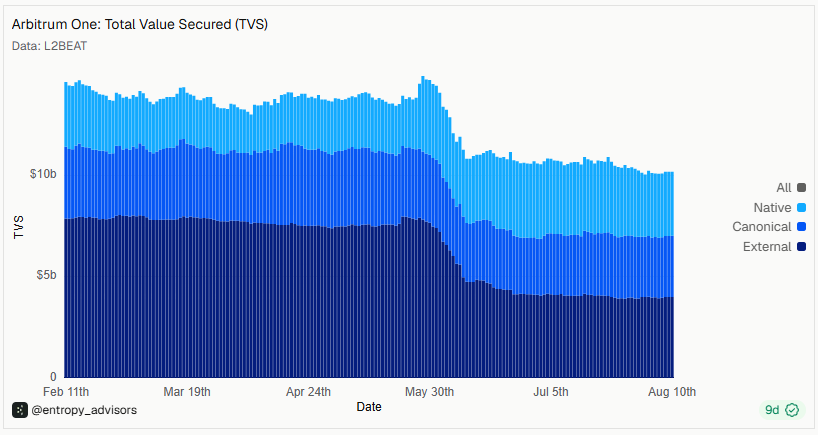
The stablecoin market cap on Arbitrum is c.$4Bn across c.11m holders. Any tokenised asset that's meant to be used rather than just held, needs a settlement asset sitting on the same chain. Redemptions, secondary trading, financing and collateral all require somebody on the other side of the transaction holding cash, and if volume isn't there, then this turns into a bridging problem with its own counterparty risk attached. Stablecoin depth is the closest available proxy for whether an asset can actually do anything once it has been issued.
The types of assets on Arbitrum are diversified and not tied to a particular issuer. This distribution of assets is healthy and resilient rather than fragile. This is further strengthened by the fact that 97.4% of RWA on Arbitrum is actually distributed rather than just represented. As opposed to 10.7% for XRP or 41.7% on Polygon. Distributed means the chain is being used as a distribution layer, where investors subscribe to, hold and manage the asset directly through their own wallets or custodians. Represented means the chain is being used as a recordkeeping layer, which improves transparency and reconciliation but does not enable onchain investor transfers. These highlight an established well-rounded ecosystem.

Finally, RWA holders on Arbitrum are up 9.24% over the last 30 days and with the recent success of the Arbitrum based Robinhood Chain it appears that momentum and the direction of growth is positive. A regulated brokerage picking a stack to put listed securities on provides insight on what institutional judgement lands on.
However if we were only looking for the deepest pool of liquidity then Ethereum mainnet would be the clear answer - still holding >45% of non-stablecoin RWA TVL.
So there must be more than just metrics.
Ecosystem support
But the reason is not gas fees. With consistently low L1 gas fees, the cost alone no longer forces anybody off mainnet. Yet Arbitrum is cheaper still, with a median transaction fee of c.$0.0034 this future proofs any changes in behaviour from growing adoption, but more importantly keeps fees predictable and consistent enough that it can be modelled in a financial forecast for us.
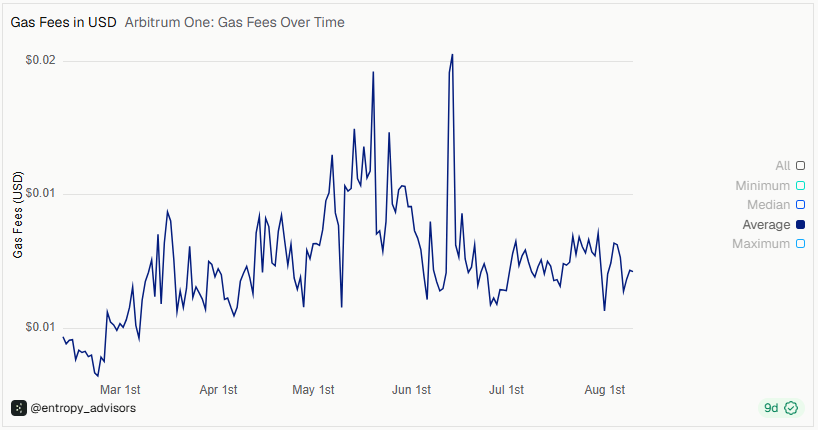
But honestly in 2026 this isn't the dealbreaker it used to be, Ethereum is processing more transactions than ever, and it has never been cheaper to use. So why not Ethereum mainnet?
Well, we have a relationship with the Ethereum Foundation and I have a lot of respect for the people there, but Ethereum's stewardship is now spread across a number of independent organisations, each with its own merit but also its own remit and its own funding. That structure has real virtues and decentralisation is very obviously one of them, though what it doesn't give a company of our size is a single door to knock on.
When we needed an intro or an answer on whether something was supported, the search cost was high and quite often nobody owned the question at all. Arbitrum has the Foundation and Offchain Labs, and between them somebody is accountable.
It's a network of coordinated entities looking to build together, and we saw that directly at Arbitrum Founder House in London this July, where we entered and took first prize in the general category against 64 products and 140 founders. This provided us with grant money but also brought to our attention efforts such as the Arbitrum Audit Program, which puts $10m behind subsidising third-party smart contract audits as well as ArbiFuel which sponsors gas so teams can onboard users while avoiding that friction.
Alignment
If it's support we're after then the obvious follow-up is why choose anything in the EVM space at all, rather than Solana, Stellar or another chain that would be equally happy to support us.
It's pretty straightforward for our application - our institutional counterparties don't assess a blockchain the way a developer does. A risk committee or compliance team doesn't ask about throughput, it asks who can change the rules and by what process, how long you would have to get out if you disagreed with a change, what happens to a client asset if the layer beneath the application fails and what the incident history looks like. Usually preference is towards battle-tested inherited security rather than aiming to establish it.
Take the incident history first, because it's the most concrete. Ethereum has been producing blocks since July 2015 and has never suffered a prolonged global halt in nearly eleven years. Solana by contrast has halted several times, most recently in February 2024, and each of those needed validators to coordinate a manual restart. To be fair to them that record has improved a great deal and Solana has now gone roughly thirty months without a network-wide outage. But the question was never how often a chain fails, it's what happens when it does. A collateral platform that can't process a liquidation for five hours because the network underneath it is being restarted has a problem it can't explain to a counterparty, and "it hasn't happened for a while" isn't the answer a risk committee is looking for. Arbitrum has cleanly posted 100% normal uptime over the past 30 days with no ongoing anomalies.
The second question is whose security you're actually relying on. Building on a chain that settles to Ethereum means the answer to who can change the rules points at a validator set that is large, independent and outside anybody's control, including ours and including the Foundation's. That's a much easier conversation than asking a counterparty to form a view on a younger validator set, or on the handful of organisations that anchor a network.
Other reasons why EVM is preferred include:
- The audit market is EVM-shaped: the overwhelming majority of serious smart contract auditors work in Solidity.
- Institutions are already here, with BlackRock, Franklin Templeton, WisdomTree and Wellington all issuing on EVM chains today, which means our counterparties' technical teams have seen contracts shaped like ours before.
- Reversibility. An EVM contract suite can move between EVM chains. If Arbitrum turns out to be the wrong call in three years, that's a redeployment. Had we built on Solana and changed our minds, it's a rewrite, a re-audit and a fresh set of integrations.
So which EVM Layer 2?
Well L2BEAT tracks 22 rollups and only six of them hold Stage 1, with only three Stage 1 chains carrying meaningful value secured at all. Arbitrum One is one of those, running permissionless fraud proofs under BoLD and posting all the data needed to reconstruct state to Ethereum itself.
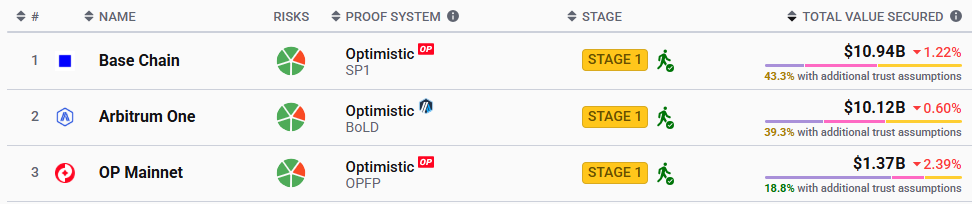
That narrows it to three chains. Optimism goes first on the numbers, carrying only c.$26m of RWAs, so whatever its technical merits the assets and issuers we would be sitting alongside aren't there yet.
Leaving only Base as a serious comparison. It secures slightly more value than Arbitrum, holds Stage 1, posts its data to Ethereum the same way. Where it differs is governance, Base upgrades require two multisigs to sign, Coinbase's coordinator multisig and an eleven-member security council, and there is no timelock between the second signature and the change taking effect. L2BEAT records the exit window as none, notes that Base has no governance token and no voting venue, and states that upgrade proposals are Coinbase-authored with no route for a third party to put one to the council. One upgrade in June 2026 went from council approval to execution in 43 minutes.
None of that is a criticism of Base's engineering, and for consumer applications that need to ship quickly it's arguably the better design. But the first question our counterparty asks is how long they would have to get out if they disagreed with a change, and on Base the honest answer is that there is no window at all. On Arbitrum it's ten days on the regular path while the emergency path doesn't provide a window, but this emergency path is the exception rather than the only path.
L2BEAT's own assessment puts the position better than I could, which is that Arbitrum "passes the walkaway test: users can exit in the presence of malicious operators even if the Security Council disappears".
Compatibility
Another important factor in our decision was the existing developer tooling and infrastructure available.
A key one is account abstraction, because it decides whether an institution can use your product at all. Our counterparties are bank treasury desks. Ask one of them to hold a balance of a volatile native token so it can pay network fees and the meeting is over, fairly so, because that's a treasury policy problem and an audit problem and it isn't ours to hand them. ERC-4337 tooling on Arbitrum means a counterparty can sign without ever holding the native asset. Gas is paid in ETH rather than a separate chain token, so there's one less asset to explain. And Offchain Labs bought ZeroDev in August 2025, which means the account abstraction layer belongs to the ecosystem rather than sitting next to it.
The rest of our stack was already there. Morpho Blue is live on Arbitrum, so our credit leg was an integration rather than a port. Safe is natively supported with a working transaction service, which means our governance boundary, a proxy admin behind a timelock behind a Safe, runs on real infrastructure rather than something we approximated. OpenZeppelin's libraries are the standard everybody builds on, and OpenZeppelin is also one of the twelve firms approved under the audit programme. Chainlink price feeds are live, including the sequencer uptime feed. Alchemy covers node access, and Dune and DefiLlama cover the data.
We wrote no bridges and no adapters. None of that is infrastructure we have to maintain.
So ultimately for us what decided it was that the assets were already there, the institutions issuing them were already there, the security model survives a compliance officer, the tooling was already deployed and there was somebody available when we needed an answer.
References
- RWA.xyz
- L2BEAT - Arbitrum One
- Dune - Arbitrum One Network Overview, Entropy Advisors
- DefiLlama - Arbitrum
- Morpho deployment addresses
- Chainlink L2 sequencer uptime feeds
- Arbitrum status and incident history
- Arbitrum Founder House London
Disclaimer: The content published on this website is provided for informational purposes only and should not be interpreted as financial, investment, or regulatory advice.